

article
ADA Requirements for EV Charging: How Many Accessible Chargers Do You Need?
As EV charging becomes a standard amenity for commercial properties, multifamily housing, and workplaces, one critical question is often overlooked:
How many EV chargers need to be ADA accessible—and where should they be placed?
Getting this wrong doesn’t just create a poor user experience. It can expose your project to compliance risks, failed inspections, and costly redesigns.
First, a Quick Clarification: ADA vs. EV Charging Codes
The Americans with Disabilities Act (ADA) does not currently provide EV-specific requirements written directly into the law.
Instead, EV charging accessibility is governed by a combination of:
- ADA Standards for Accessible Design
- State building codes (like California’s CALGreen)
- Guidance from the U.S. Access Board
The result is that there is no single national rule. Requirements come from layered standards that vary by jurisdiction.
Using California as the Leading Example
California has some of the clearest and most widely adopted EV charging accessibility rules, making it a strong model even if your project is in another state.
Under California code (including CALGreen and the California Building Code), requirements generally include:
Minimum Number of Accessible EV Spaces:
- One accessible EV space minimum for small installations
- Increasing ratios as charger count grows
- Typically one must be van-accessible
Typical Ratios (Simplified):
- 1–25 chargers: at least 1 accessible
- 26–50 chargers: 2 accessible
- 51–75 chargers: 3 accessible
Exact requirements depend on project type and jurisdiction, so always verify locally.
Accessible EV Charging Is Not the Same as Standard ADA Parking
This is where many projects get tripped up.
An accessible EV charging space must meet both:
- ADA parking requirements
- EV charging functionality
That means:
- Proper stall width and access aisle
- Accessible route to the building
- Charger equipment that is reachable and usable
You cannot simply place a charger in an ADA parking space and assume compliance.
The Two Types of Accessible EV Charging Spaces
Most codes, including California’s, require two categories.
Van-Accessible EV Charging Spaces
- Wider stall with a larger access aisle
- Designed for wheelchair lift access
- At least one required in most installations
Standard Accessible EV Charging Spaces
- Slightly smaller than van-accessible
- Still require an access aisle and accessible route
How Many Van-Accessible vs. Standard Accessible EV Chargers Do You Need?
When determining the mix of van-accessible and standard accessible EV charging spaces, most jurisdictions (including California guidance) follow a clear baseline:
- At least one accessible EV charging space must be van-accessible
- Additional accessible spaces can typically be standard accessible
In practice, this means:
- 1 accessible charger → 1 must be van-accessible
- 2–4 accessible chargers → 1 van-accessible + remaining standard
- 5+ accessible chargers → still typically 1 van-accessible (unless local code requires more)
This distinction matters because van-accessible spaces are not just larger—they are specifically designed to accommodate wheelchair lifts and ramps, requiring additional width and clearance that standard accessible spaces do not provide. From a layout perspective, van-accessible chargers should be placed closest to building entrances and along accessible routes, with careful attention to charger reach, cable management, and operability from a seated position.
Because these spaces take up more room, they can impact parking density and site design, which is why it is critical to plan for accessibility early and integrate it into the overall charging strategy rather than treating it as a last-minute requirement.
Placement Rules: Where Accessible Chargers Must Go
Accessibility is just as much about location as it is about dimensions.
Accessible EV chargers must:
Be on an Accessible Route
- Continuous path to building entrances
- No stairs or steep slopes
Be Located Near Key Destinations
- Close to entrances, elevators, or primary access points
- Not isolated in remote areas of the parking lot
Include Proper Access Aisles
- Clearly marked and protected
- Not shared with vehicle traffic
Charger Equipment Accessibility (Often Missed)
Even if your parking space is compliant, the charger itself must also be accessible.
This includes:
- Reachable controls and screens
- Usable connectors and cable management
- Clear and operable interface
Paired Power systems are designed with usability in mind, including intuitive interfaces and mobile-based activation that reduce physical interaction barriers
The Biggest Mistake Developers Make
Most teams treat accessibility as a late-stage requirement.
That leads to:
- Last-minute layout changes
- Lost parking efficiency
- Expensive retrofits
Instead, accessibility should be designed from the very beginning, alongside power, layout, and future demand.
Accessibility and Scalability Go Together
The best EV charging designs do not just meet minimum requirements. They scale.
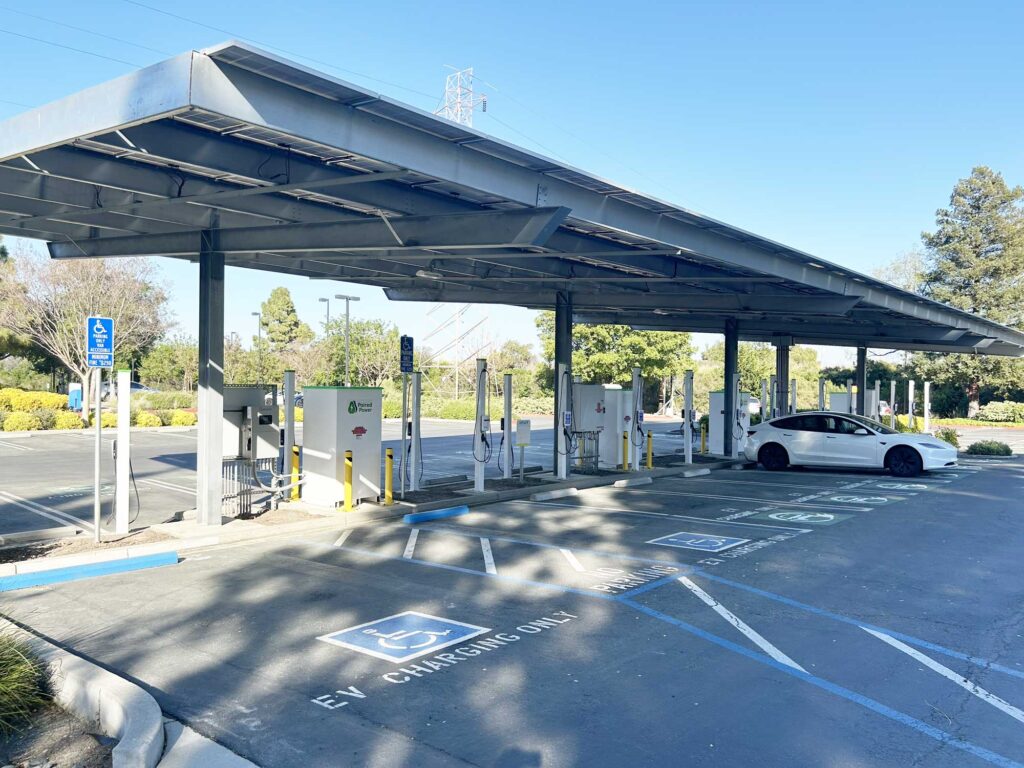
Solutions like PairFleet (pictured above) allows organizations to:
- Install more chargers without major grid upgrades
- Integrate accessible chargers seamlessly into the system
- Support future EV adoption without redesign
The Bottom Line
To stay compliant and competitive, your EV charging plan should:
- Include accessible chargers from day one
- Follow placement and usability best practices
- Be designed for future expansion, not just minimum code
Source Links and Where to Verify Requirements
Always confirm with your local jurisdiction, as requirements vary by state and city.
ADA Standards for Accessible Design (U.S. DOJ)
https://www.ada.gov/law-and-regs/design-standards/
U.S. Access Board – Electric Vehicle Charging Guidance
https://www.access-board.gov/tad/ev/
U.S. Department of Energy – ADA Compliance for Electric Vehicle Charging Infrastructure
https://afdc.energy.gov/fuels/electricity-ada-compliance
California Building Code (CBC)
https://www.dgs.ca.gov/BSC/Codes
CALGreen Code (California Green Building Standards)
https://www.dgs.ca.gov/BSC/CALGreen
Need Help Designing a Compliant EV Charging System?
Paired Power can help you:
- Plan for the right number of chargers and accessible chargers
- Consider additional infrastructure to lower demand charges and increase charging capacity
- Optimize energy usage for cost, grid capacity, prioritized vehicle charging and future demand
Contact us for a free estimate at pairedpower.com/contact.