

article
AI Data Centers Are Eating Up Grid Capacity. Your EV Charging Project Does Not Have to Wait.
The New EV Charging Problem No One Can Ignore
If you have tried to install EV chargers at a fleet depot, school district transportation yard, commercial campus, warehouse, municipal lot, or public agency facility in the last few years, you may have heard some version of this from your utility:
- There is not enough power available.
- The transformer upgrade will take years.
- The timeline is uncertain.
- The site may need costly electrical infrastructure before chargers can be installed.
- Once the new infrastructure is finally ready, charging spikes during peak demand periods could cause exorbitant utility bills.
That is not a small project delay. It is the new reality of electrification.
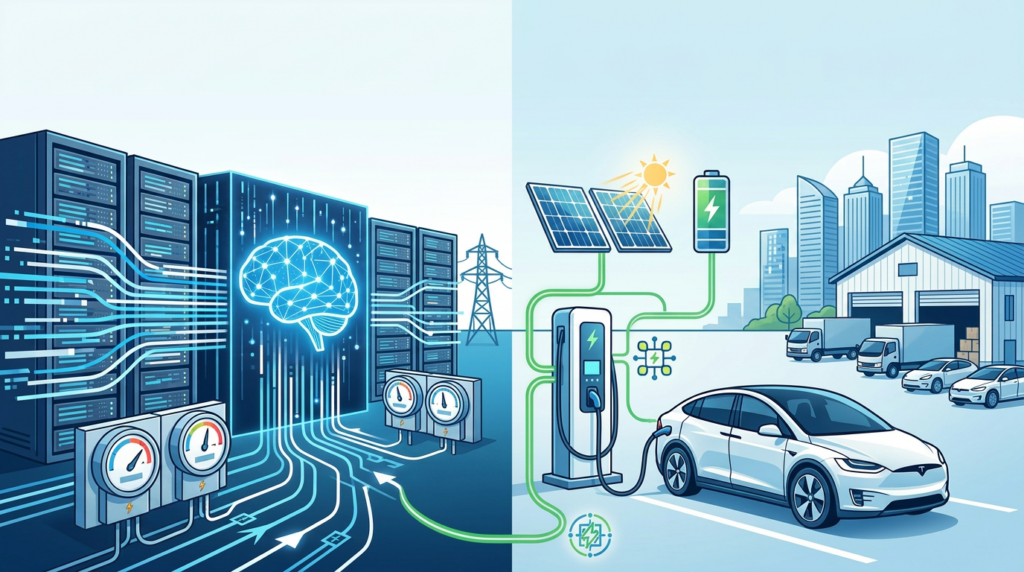
EV charging demand is arriving at the same moment the grid is being asked to support massive new loads from AI data centers, building electrification, manufacturing, and transportation electrification. A 2024 Lawrence Berkeley National Laboratory report found that U.S. data centers used approximately 4.4% of the nation’s electricity in 2023, with projections showing that number could rise to as much as 12% by 2028.
That matters because the same grid being asked to power the AI boom is also the grid being asked to support electric fleets, electric school buses, workplace charging, municipal charging, and commercial EV infrastructure.
For organizations trying to electrify transportation, the message is clear: waiting for the grid to catch up may no longer be a practical strategy.
EV Charging Has Become a Grid Capacity Problem
For years, EV charging projects were often treated like straightforward electrical upgrades. Choose the chargers. Pull power to the site. Install the equipment. Start charging.
That model breaks down when the available electrical capacity at the site cannot support the number of vehicles that need to charge.
A few Level 2 chargers may be manageable. But fleets, workplaces, school districts, and commercial campuses are not planning for one or two EVs anymore. They are planning for dozens, hundreds, or eventually thousands of electric vehicles.
That creates two immediate problems.
- First, the site may not have enough available electrical capacity to support the charging load.
- Second, even when enough power can be delivered, unmanaged charging can create expensive demand spikes that drive up monthly utility bills.
Commercial demand charges are often based on the highest peak power demand during a short billing interval, commonly 15 minutes. Reducing peak demand can lower electricity costs, particularly for flexible loads like EV charging.
In other words, your EV charging project is not just about chargers. It is about power availability, power timing, peak demand, utility tariffs, site operations, load management and energy management.
The Utility Upgrade Timeline Is Becoming a Business Risk
The grid is not standing still. Utilities are investing in infrastructure. New generation and storage projects are being developed. Planning is underway.
But those timelines are long, in many cases years long.
Lawrence Berkeley National Laboratory’s 2024 “Queued Up” report found that nearly 2,600 GW of generation and storage capacity was seeking grid connection at the end of 2023, and that interconnection wait times have grown significantly, with a median of five years for projects built in 2023.
That report focuses on generation and storage projects, not every facility-level service upgrade. But it illustrates the bigger issue: adding capacity to the grid is slow, complicated, and increasingly over-subscribed.
For organizations with electrification deadlines, that delay can create real operational risk such as:
- A fleet may already have EVs on order.
- A school district may already have electric buses arriving in the fall.
- A municipality may already have climate goals or fleet conversion requirements that must be met.
- A workplace may already be under pressure to expand employee EV charging.
- A commercial property may already need charging infrastructure to remain competitive.
If the charging plan depends entirely on a utility upgrade that may take years, the business case starts to fall apart.
The Hidden Cost: Demand Charges Can Make EV Charging More Expensive Than Expected
Even when a site can get enough power, the utility bill can become a shock.
EV charging creates concentrated load. If vehicles plug in at the same time, or if high-power chargers operate simultaneously, the site can create a short but expensive spike in electricity demand. That spike can affect the entire month’s bill.
This is one of the most overlooked problems in EV charging economics.
The cost of electricity for EV charging can vary dramatically depending on station design, utilization, and utility rate structure. NREL research has found that demand charges can significantly affect the cost of electricity for charging applications, especially when utilization is low or charging demand is not managed.
That means the “charger price” is not the real cost of adding charging infrastructure.
The real cost includes:
- Utility upgrades
- Trenching and construction
- Transformer delays
- Peak demand charges
- Time-of-use rates
- Operational downtime
- Buying and depreciating EVs for which there is no charger infrastructure
- Chargers that cannot be fully used because the site lacks capacity
For many organizations, the problem is not whether they can buy chargers. The problem is whether they can power them affordably.
The Old EV Charging Playbook Is No Longer Enough
The traditional approach to EV charging says:
- Install chargers.
- Request more utility power.
- Wait for the upgrade.
- Pay the demand charges.
- Hope the system scales later.
That may have worked when EV adoption was slower and grid capacity was easier to access. But it is a risky strategy in a world where AI data centers, industrial electrification, building electrification, and transportation electrification are all competing for power at the same time.
The question is not simply, “How many chargers can we install?”
The better question is:
“How much usable charging capacity can we create, control, store, and optimize at this site?”
That is where solar EV charging microgrids change the equation.
Solar EV Charging Microgrids Help You Stop Waiting for the Grid
A solar EV charging microgrid creates and manages energy where the vehicles are parked.
Instead of relying entirely on utility power, the system can combine:
- On-site solar generation
- Battery energy storage
- EV chargers
- AI-assisted energy and load management software
- Managed charging controls
- Real-time monitoring
- Optional grid connection
- Future-ready virtual power plant (VPP) and grid-interactive capabilities
The result is not just an EV charger installation. It is an energy system designed to help your organization charge more vehicles with less dependence on utility upgrades and less exposure to peak demand costs.
Paired Power’s microgrid design approach is built around this idea: generate clean energy on-site, store it intelligently, and deliver it to vehicles when it creates the most value.
What a Solar EV Charging Microgrid Can Do That Standard Chargers Cannot
A conventional charger depends almost entirely on the grid capacity available at that site.
A solar EV charging microgrid can change the site’s entire energy profile by:
- Generating electricity on-site during the day
- Storing solar energy in batteries for later use
- Reducing the amount of power pulled from the grid, especially during expensive peak periods
- Prioritizing vehicles based on operational needs
- Managing charging sessions to avoid costly demand spikes
- Helping keep vehicles charged even when grid capacity is limited
- Supporting future energy programs such as Virtual Power Plant participation, demand response, and other grid-interactive opportunities
These features and benefits are especially important for fleets and facilities that cannot afford to wait years for utility infrastructure.
The Payback Story Is Bigger Than Sustainability
Solar EV charging microgrids are often framed as a sustainability solution. They are. But the business case is often just as compelling.
For many organizations, the financial value comes from avoided utility costs, reduced demand charges, reduced fuel costs, avoided or minimized utility upgrades, and faster deployment.
In many cases, the energy savings alone can support a payback period of as little as two to five years.
That is the part many decision-makers miss.
This is not just about doing the right thing for the environment. It is about building EV charging infrastructure that can actually work within the financial and operational realities of the site.
A traditional charging project may look cheaper on paper until the organization discovers the cost of the utility upgrade, the construction timeline, the demand charges, and the operational limits of unmanaged charging.
A solar EV charging microgrid may solve more of the actual problem at lower total cost of ownership.
Why Paired Power’s Approach Is Different
Paired Power designs solar-powered, battery-backed, AI-managed EV charging solutions for organizations that need reliable charging without being trapped by grid limitations.
Our solutions are designed for real-world deployment at:
- Fleet yards
- Commercial campuses
- School districts
- Municipal facilities
- Workplaces
- Public agencies
- Transit and logistics sites
- Remote or infrastructure-constrained locations
- Emergency response and resilience locations
Paired Power’s PairFleet solution is designed to help organizations install more chargers using existing grid capacity, reduce demand charges, and scale EV charging for workplaces, fleets, and commercial applications.
Our design and modeling process can also begin before anything is built. Pairiscope, our design software, helps simulate microgrid and EV charging system performance so customers can evaluate solar, storage, grid capacity, charger type, utility costs, and energy management strategies before committing to a final project plan.
That matters because the best EV charging projects are not guessed into existence. They are modeled, optimized, and engineered around the realities of the site.
A Better Way to Plan EV Charging
Before investing in EV charging infrastructure, organizations should be asking:
- How much power is actually available at this site?
- How many vehicles need to charge each day?
- How many miles of range does each vehicle need?
- When are vehicles parked and available to charge?
- What happens if all vehicles plug in at once?
- What utility tariff applies?
- How much will demand charges affect the monthly bill?
- Can solar reduce grid dependence?
- Can batteries reduce peak demand?
- Can managed charging reduce operating costs?
- Can this system scale as the fleet grows?
- Can the system participate in future grid programs?
These are not minor technical details. They determine whether the charging project succeeds or becomes an expensive bottleneck.
EV Charging Infrastructure Should Be Designed Like an Energy System
The organizations that succeed with electrification will be the ones that stop thinking about EV charging as a simple equipment purchase.
EV charging is not just hardware. EV charging is:
- Energy strategy
- Fleet readiness
- Utility cost control
- Resilience
- Infrastructure planning
- A long-term operational asset
That is why Paired Power combines solar generation, battery storage, EV charging, energy modeling, managed charging, and AI-assisted software into integrated solutions.
The goal is not just to install chargers.
The goal is to create a smarter energy system that helps customers charge more vehicles, reduce operating costs, avoid unnecessary grid upgrades, and prepare for the future of electrified transportation.
The Future of EV Charging Will Be Grid-Interactive
The next generation of EV charging infrastructure will not simply draw power from the grid. It will interact with the grid.
That means charging systems will increasingly need to support:
- Managed charging
- Demand response
- Peak shaving
- Solar and battery integration
- Vehicle-to-Grid readiness
- Virtual Power Plant participation
- Resilience during outages or grid constraints
- Energy cost optimization
- Fleet scheduling and prioritization
This is where solar EV charging microgrids become more than a workaround. They become a strategic energy asset.
A well-designed system can help an organization charge vehicles today while preparing for the energy markets, utility programs, and grid needs of tomorrow.
Stop Waiting for the Grid to Be Ready
The AI data center boom is not slowing down. EV adoption is not slowing down. Fleet electrification is not slowing down. Utility infrastructure will continue to improve, but the timeline may not match your organization’s timeline.
If your fleet, campus, school district, municipality, or commercial site needs EV charging now, waiting years for more grid capacity may not be the best answer.
A solar EV charging microgrid can help you take control of the problem and:
- Generate power on-site.
- Store it intelligently.
- Manage charging in real time.
- Reduce demand charges.
- Avoid unnecessary utility upgrades.
- Build resilience.
- Charge more vehicles with the power you already have.
Ready to See What a Solar EV Charging Microgrid Could Do for Your Site?
Paired Power helps organizations design and deploy intelligent solar EV charging microgrids that make electrification faster, smarter, and more cost-effective.
If grid constraints, utility upgrade timelines, or demand charges are slowing down your EV charging plans, it’s time to stop waiting for the grid and start building your own clean energy capacity.
Contact Paired Power for a free project design to learn how a solar EV charging microgrid could work at your site.