

case study
Case Study: How Intuit’s San Diego Office Achieves 110,000 Annual Miles of Emissions-Free Commuting on Net-Zero Grid Energy
| 24 EV CHARGING POSITIONS DELIVERED | 110,000+ MILES OF EMISSIONS-FREE COMMUTING, YEAR ONE | ~80% REDUCTION IN ENERGY & DEMAND COSTS | < 5 yrs PAYBACK PERIOD |
How a Fortune 500 fintech company added 24 EV charging positions on its San Diego campus using just 20 kW of available grid capacity—and now delivers 110,000+ miles of emissions-free commuting on net-zero grid energy.
THE CHALLENGE
Intuit’s San Diego campus had a problem familiar to almost every commercial workplace in the country: ambitious EV adoption goals, a parking facility full of employees who wanted to charge at work, and a utility grid that simply couldn’t keep up.
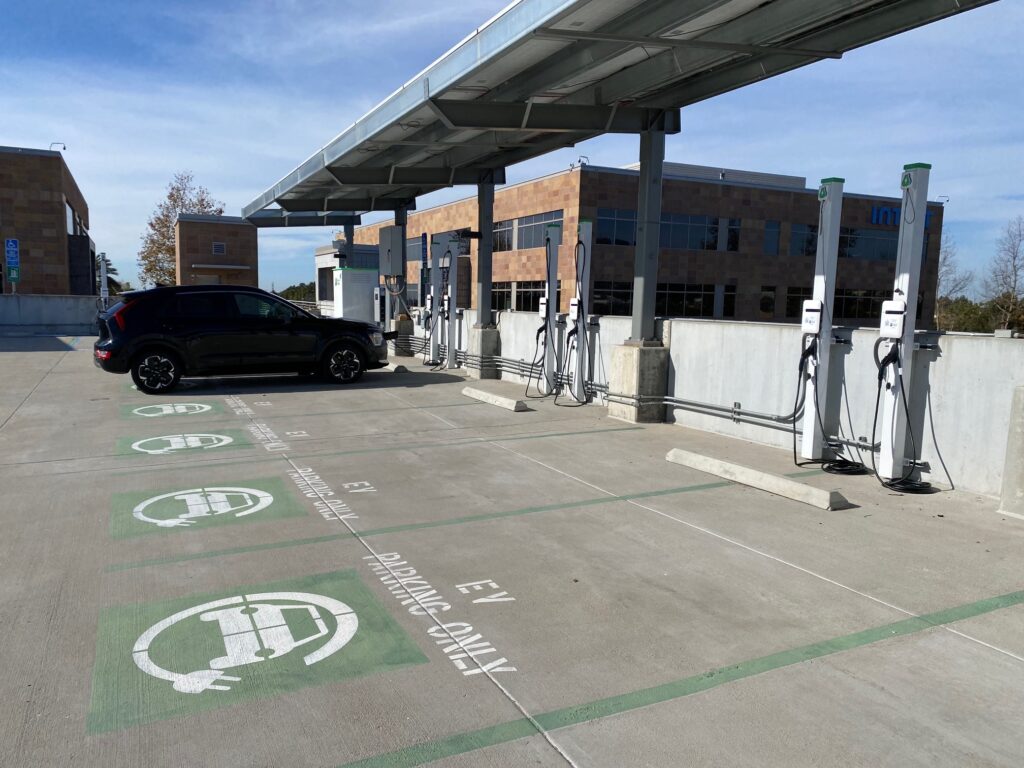
The target site was the top deck of a four-story parking garage. The available grid circuit, 208V single-phase at 160 amps, offered only about 20 kW of usable capacity—enough for roughly three Level 2 chargers. The traditional path forward—working with the local utility (San Diego Gas & Electric) to add a new transformer, secondary conductors, and switchgear—would have meant a multi-year wait for grid upgrades, supply-chain delays on transformers, and ongoing exposure to commercial demand charges that can run as high as $29 per kW in summer peak periods on top of energy costs of 11 to 22 cents per kWh.
Intuit needed to:
■ Charge approximately 24 employee EVs every workday, on the top deck of a parking garage with severely limited grid capacity.
■ Avoid the multi-year wait for utility grid upgrades and the supply-chain queue for transformers and switchgear.
■ Eliminate or sharply reduce exposure to demand charges and high commercial energy rates.
■ Offer charging as a meaningful employee benefit and adoption driver—not as a stalled IT-procurement project.
■ Advance the company’s net-zero commitment with grid-independent, on-site renewable energy.
THE SOLUTION
Paired Power designed and deployed an integrated solar-powered microgrid charging system that turned 20 kW of available grid into a fully adequate charging facility for 24 EVs:
■ 66 kW of solar PV mounted on canopies above the top-deck parking spaces (recommended at 45 kW by the design tool, intentionally oversized for resilience and net-export).
■ 170 kWh of battery energy storage using lithium iron phosphate (LFP) chemistry—chosen for its safety profile, particularly important given heightened scrutiny of battery storage in California parking-garage applications.
■ 24 Level 2 EV charging positions, deployed as four sub-systems of six chargers each, allowing the system to manage charging loads intelligently across groups.
■ PairFleet™ system, including AI-driven energy and load management software, which time-shifts solar generation, manages charging sessions, and orchestrates the battery to keep the site within its 20 kW grid envelope.
■ Pairiscope™ design software, used during planning to model the entire system before any chargers were installed or panels were wired.
■ Turnkey permitting and AHJ coordination handled by Paired Power for the original installation and the subsequent battery + software upgrade.
The result is a self-contained microgrid charging facility that operates almost entirely on its own solar generation, with the utility grid acting as a small backup rather than the primary energy source.
How It Works
| Solar generation | The 66 kW PV array generates approximately 114,000 kWh annually—commonly producing 200 to 400 kWh on a typical day. Solar yield is modeled using national weather databases tied to the project address. |
| Battery storage & time-shifting | The 170 kWh LFP battery stores midday solar surplus and discharges it during peak demand-charge windows, evening commutes, and any cloudy stretches that would otherwise force the system to draw from the grid. Battery dispatch is managed continuously by the PairFleet platform. |
| Managed charging across 24 positions | PairFleet’s AI-driven scheduler manages charging sessions across all 24 positions in real time—balancing each driver’s needed range, the available solar, the battery state of charge, and the strict 20 kW grid envelope. Drivers experience consistent charging without the system ever spiking grid demand. |
| Net-zero on many days | On a representative day during the case study period, the system delivered approximately 400 kWh to vehicles, drawing only 113 kWh from the grid while solar provided 314 kWh. On especially sunny days—June 30, 2025 being one example—the site exported more energy back to the grid than it consumed, operating net-negative on grid usage. |
RESULTS & IMPACT
| Charging capacity unlocked | Where the existing grid circuit could support only three to four Level 2 chargers, the integrated solar microgrid delivers 24 charging positions—a 6× to 10× multiplier on equivalent grid capacity. Each EV typically receives 50 to 200 miles of range per workday, depending on dwell time and battery state. |
| Emissions-free commuting at scale | Since launch, the system has delivered more than 110,000 miles of emissions-free commuting to Intuit employees—the equivalent of more than four trips around the world—while drawing essentially no net energy from the utility grid. |
| Cost reduction | Comparable unmanaged commercial charging at this scale would have cost Intuit on the order of $50,000 per year in energy and demand charges. The solar microgrid configuration cut that to roughly $6,000 per year—a reduction of approximately 80% in energy and demand cost exposure. |
| Payback under five years | Including the solar, battery and PairFleet system design and software upgrades, Intuit’s payback period on the project is under five years—before considering the harder-to-monetize benefits of accelerated EV adoption, employee retention, and avoided utility upgrade timelines. |
| Adoption explosion | After the upgrade to PairFleet, Intuit observed a tenfold increase in employee use of the Paired Power stations. A site that had been viewed as inconvenient (top deck of a four-story garage) became one of the most utilized employee benefits on campus. |
| Permitting & AHJ navigation | Paired Power handled the entire permit process for both the original installation and the subsequent upgrade—removing the burden from Intuit’s internal real-estate, sustainability, and IT teams and shielding the project from the procedural delays that often stall workplace charging projects. |
IN THE CUSTOMER’S WORDS
Tom Harrington served as Global Commute Solutions Leader for Intuit Workplace from the project’s inception through its post-upgrade success. (Mr. Harrington has since retired.) Speaking publicly about the project in September 2025, Mr. Harrington described what the solar microgrid solution unlocked for Intuit:
“From a capacity standpoint, we’ve really had some problems with infrastructure capacity, and Paired Power has allowed us to leapfrog that grid capacity and deliver solutions to our customers where we basically didn’t have the ability to add more stations.”
— Tom Harrington, Global Commute Solutions Leader, Intuit Workplace (ret.)
“Adding battery storage and the new software platform turned them into an overnight success. We’ve seen a tenfold increase in folks using the Paired Power stations since we’ve launched the PairFleet product.”
— Tom Harrington, Intuit Workplace (ret.)
“It shows that we’re saving at least 80% on our energy cost, and it’s probably higher than that. Our payback period on this investment, including the upgrade, has been less than five years.”
— Tom Harrington, Intuit Workplace (ret.)
“From a sustainability standpoint, we love that what we can do is offer grid-independent charging to our workers.”
— Tom Harrington, Intuit Workplace (ret.)
WHY THIS PROJECT MATTERS FOR FLEET ELECTRIFICATION
The grid-capacity story at Intuit’s San Diego campus is the same story that confronts school districts and commercial operators as they electrify vehicle fleets. Depots and route stops were never designed to deliver hundreds of kilowatt-hours per night to fleets of vehicles each carrying 138 to 387 kWh of battery. Utility upgrades take years; transformer queues are long; demand charges are punishing; and waiting for the grid to catch up is not an option for fleets under pressure to deliver service today.
The Intuit project demonstrates—at a real, operating site, with a publicly traded customer and verifiable performance data—that integrated solar plus battery plus AI-managed charging can:
■ Deliver 6× to 10× the charging capacity of the existing grid circuit, without waiting for utility infrastructure upgrades.
■ Operate net-zero on grid energy on a meaningful share of days throughout the year, advancing fleet sustainability commitments.
■ Cut energy and demand charges by approximately 80%, materially lowering the total cost of ownership of an electrified fleet.
■ Pay back capital investment in under five years on a workplace-charging cost basis—a profile that translates directly to depot-charging economics for fleet operators.
■ Drive deep operational adoption—the tenfold use increase Intuit experienced demonstrates what happens when charging actually works the way drivers and operators need it to.
The same software pillars that made this project successful at Intuit—Pairiscope™ for design, PairFleet™ for energy and load management, and the underlying microgrid architecture—are directly applicable to electric school bus depot charging, route-stop charging, and the managed-charging and VPP-readiness frameworks fleet operators are advancing today.
PROJECT TEAM
| Project Lead | Tom McCalmont, P.E. CEO, Paired Power — project lead and oversight. |
| Engineering & Delivery | Paired Power — integrated electrical engineering services covering solar PV, battery energy storage, and EV charger design and interconnection. |
| Energy Management | PairFleet™ — AI-driven energy and load management software platform. |
| Design & Modeling | Pairiscope™ — microgrid design and modeling software. |
| Turnkey Delivery | Installation, permitting, and AHJ coordination handled end-to-end by Paired Power. |
| Hit your EV charging goals without waiting for the grid. Talk to Paired Power about scaling your site’s charging capacity, slashing demand charges, and paying back in under five years — contact us for a free consultation. |
References: Customer quotes and other details were pulled from Paired Power’s recorded webinar event on September 18, 2025: How Intuit Expanded EV Charging Without Waiting for Grid Capacity.