

blog
What Happens If Every Vehicle in California Goes Electric Tomorrow?
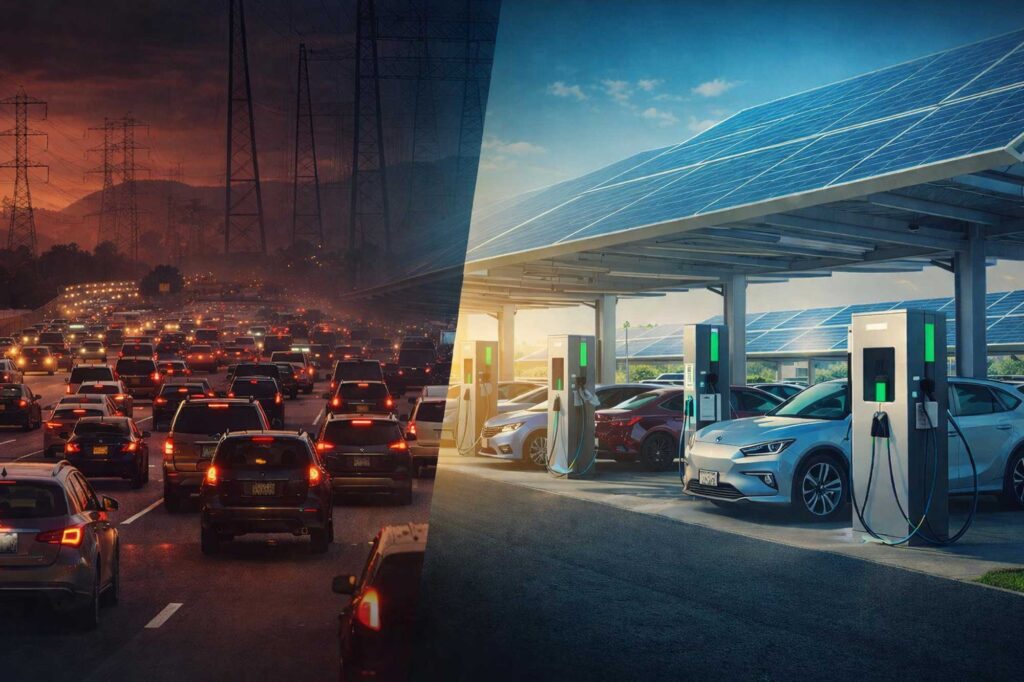
Imagine This
What if every vehicle in California became electric tomorrow?
No gas. No diesel. Just electricity.
The carbon savings would be massive—and the air in our cities would start getting cleaner almost immediately.
It sounds wonderful—until you ask one question:
Can the grid actually handle it?
The Problem Is Bigger Than You Think
California has about 31 million vehicles on the road.
Together, they drive over 300 billion miles every year.
That’s a massive system powered today by gasoline and diesel.
If we switch all of that to electricity, we’re not just adding a little extra demand—we’re adding a huge new layer of load to the grid.
Even with EVs being more efficient, electrification would still add tens to over 100 terawatt-hours of new electricity demand per year.
That’s a big jump.
The Real Problem Isn’t Energy — It’s Timing
Here’s the part most people miss.
The grid doesn’t fail because of how much energy we use over a year.
It fails because of how much power is needed at the same time.
Think about it:
- Everyone plugs in at work around 8am
- Everyone plugs in at home around 6pm
That creates massive spikes.
And the grid—especially at the local level—wasn’t built for that.
That’s why companies trying to install EV chargers hear things like:
- “You need a transformer upgrade”
- “This will take 2–3 years”
- “You don’t have enough capacity”
The bottleneck is real.
The Grid Problem Is Local
This isn’t just a statewide issue—it shows up at individual buildings.
A site might have enough power for:
- 10 chargers today
But near-term demand for:
- 50 or 100 chargers
That gap is what’s slowing down EV adoption.
A Smarter Way Forward
At Paired Power, we’ve taken a different approach.
Instead of waiting years for grid upgrades, we ask:
How do we get more out of the power that’s already there?
The answer is combining:
- Smart (AI-driven) charging software
- Available grid capacity
- On-site solar
- Battery storage
Charge 6x As Many EVs As Available Grid
When you combine multiple energy sources, something powerful happens:
You can charge up to 6× more vehicles using the same grid capacity.
Here’s how:
- Charging is staggered instead of all happening at once
- Power is shared across vehicles
- Batteries handle spikes instead of the grid
- Solar adds extra energy during the day
So instead of overwhelming the system, you’re working with it.
The Hidden Cost Most People Miss
Commercial electric bills aren’t just based on how much energy you use (kilowatt-hours, kWh).
They’re often based on your highest spike in power (kilowatts, kW).
So if a bunch of EVs start charging at once, your bill can jump dramatically.
That’s where smart energy management makes a huge difference.
Using Paired Power’s design tool, Pairiscope, organizations can model:
- When vehicles charge
- How much power they use
- How much range they need
- What that does to their electric bill
Then optimize everything before installation.
The result is lower costs, fewer surprises, and in many cases lower costs and a compelling ROI when solar and storage are included.
What This Means for California
If every vehicle went electric tomorrow, the challenge wouldn’t just be generating enough electricity.
It would be delivering enough power, in the right places, at the right times.
That’s the real gap.
But it’s also solvable.
Because EV charging doesn’t have to behave like a traditional load.
It can be:
- Flexible
- Managed
- Optimized in real time
And when it is, we can scale EV adoption much faster—without waiting on massive grid upgrades.
The Bigger Opportunity
Transportation is still the largest source of greenhouse gas emissions in California—about 37%.
Electrifying vehicles means:
- Cleaner air
- Lower long-term fuel costs
- A major step toward reducing emissions
But getting there requires more than just EVs.
It requires smarter energy systems.
Final Thought
Let’s go back to where we started.
Imagine every vehicle in California suddenly became electric.
At first glance, it feels impossible—like the grid would be overwhelmed overnight.
And if everyone plugged in and pulled power the old way… it probably would be.
But now imagine something different.
Imagine those same vehicles charging on systems that:
- Share power intelligently
- Avoid peak demand spikes
- Store energy and use it when it’s needed
- Generate additional power with on-site solar
Suddenly, the equation changes.
Instead of overwhelming the grid, we’re working with it—stretching every kilowatt further than ever before.
That’s the real breakthrough.
Not just more power… but more output from the same power.
And while no single solution replaces the need for grid investment, this approach can dramatically increase how many EVs we can support today—without waiting years for upgrades.
In other words, if every EV in California were charging on intelligently managed, solar-plus-storage systems like Paired Power’s, we could support far more vehicles on today’s grid than most people think.
The future isn’t years away. It’s already here.
Contact Paired Power to learn more.
Sources:
- Federal Highway Administration (FHWA) – Vehicle Registrations
https://www.fhwa.dot.gov/policyinformation/statistics/2024/mv1.cfm - Federal Highway Administration (FHWA) – Vehicle Miles Traveled
https://www.fhwa.dot.gov/policyinformation/statistics/2024/vm2.cfm - U.S. Energy Information Administration (EIA) – California Electricity Data
https://www.eia.gov/electricity/state/california/ - U.S. Energy Information Administration (EIA) – Transportation Energy Consumption
https://www.eia.gov/state/seds/ - California Air Resources Board (CARB) – GHG Inventory
https://ww2.arb.ca.gov/ghg-inventory-data - Paired Power – Pairiscope (Microgrid Design Software)
https://pairedpower.com/solar-ev-charging-infrastructure-design-pairiscope/ - Paired Power – PairFleet (EV Charging Solution for Workplaces & Fleets)
https://pairedpower.com/fleet-electrification-solar-ev-pairfleet/