


case study
Commercial EV Charging at Scale: How Companies Save $136K Annually with Solar + Battery Workplace EV Charging
Charging 50 electric vehicles (EVs) per day in a company parking lot can easily result in six-figure utility bills. But with the right technology in place, these workplace EV charging costs can also become one of the most powerful opportunities for long-term cost savings.
In this case study, we examine how one large-scale employee EV charging operation is able to save over $136,000 per year—simply by deploying Paired Power’s innovative solar, battery, and software solution.
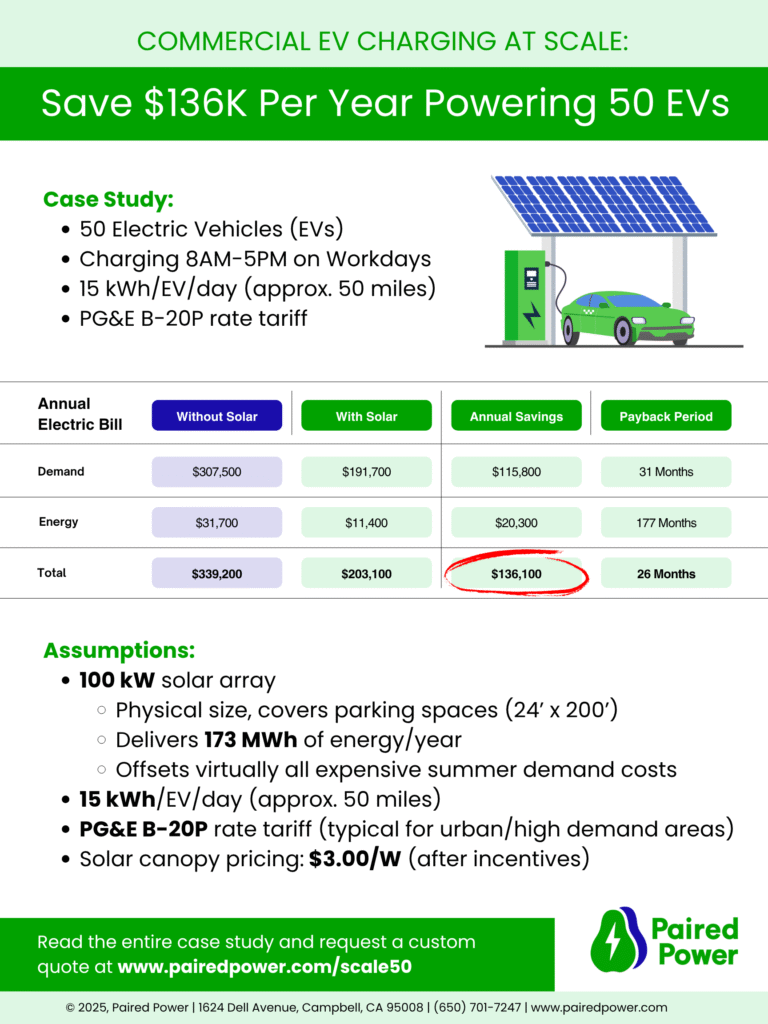
FIGURE 1: Infographic, How Companies Save $136k Per Year Powering 50 EVs
The Hidden Cost: Understanding Demand Charges
Most commercial utility customers are familiar with their energy charges—the cost of the total kilowatt-hours (kWh) consumed each month. But for companies scaling EV charging infrastructure for employees or fleets, energy charges often pale in comparison to demand charges.
Demand charges are fees based on your highest 15-minute interval of energy usage during a billing cycle. Utilities assess these charges to cover the infrastructure needed to handle your peak power draw. The more EVs you plug in simultaneously at your corporate EV charging stations, the higher your instantaneous demand, and the steeper your demand charges will be.
For commercial workplace charging sites, demand charges can represent the majority of the electric bill. This creates a major financial challenge for companies attempting to scale onsite EV charging for employees or fleets.
The Scenario: 50 Workplace EV Chargers
In this example, a commercial customer seeking to support 50 EV chargers for employees, operating during normal work hours (8 AM to 5 PM), with each vehicle requiring approximately 15 kWh per day. This daily energy need corresponds to about 50 miles of range, which is typical for many employees’ roundtrip commutes. The utility tariff in this example is a typical one for commercial businesses located in high demand cost urban areas such as California and the East Coast.
Without solar or storage, the additional load from the new EV chargers will result in an annual electric bill of:
- Demand Charges: $307,500
- Energy Charges: $31,700
- Total Annual Energy Cost: $339,200
Clearly, demand charges are the dominant cost driver.
The Paired Power Solution
For this use case, Paired Power can deploy a 100 kW solar canopy system integrated with its proprietary battery storage and smart energy management software. Key features include:
- Solar Canopy: Sized to fit over existing parking lots, generating 173 MWh/year
- Energy Storage: Absorbing excess solar during the day and shaving peak demand
- AI-Powered Software: Actively managing loads to minimize demand spikes across multiple EV charging stations
With this system in place, the customer’s revised annual electric bill is projected to drop to:
- Demand Charges: $191,700
- Energy Charges: $11,400
- Total Annual Energy Cost: $203,100
Total Annual Savings: $136,100
By deploying Paired Power’s integrated solar and storage solution for workplace EV charging, this example customer reduces their annual utility bill by over $136,000.
These substantial savings are achieved by directly cutting both energy consumption and, more importantly, peak demand charges—the largest cost driver for many commercial EV charging installations. This recurring reduction in operating expenses provides ongoing financial relief and improves overall cost predictability for companies scaling corporate EV charging stations.
Payback Period: 2 Years
Because these savings are generated through consistent reductions in operating costs, the initial capital investment in Paired Power’s solar canopy and battery storage system pays for itself in as little as roughly 2 years.
This estimate includes purchasing incentives such as the Federal Investment Tax Credit (ITC) for solar energy.
Once the system has recouped its upfront cost, businesses continue to realize significant ongoing savings, transforming what would otherwise be rising workplace EV charging utility expenses into long-term financial gains.
Why Paired Power Works
The secret to these savings lies in Paired Power’s integrated approach for commercial EV charging infrastructure:
- Solar Generation cuts down on both energy charges and peak demand.
- Battery Storage absorbs solar oversupply and releases energy strategically during peak load periods.
- AI-Powered Software optimizes charging schedules and load management in real-time across multiple EV charging ports.
This combination allows companies to avoid expensive demand spikes without sacrificing operational performance or EV charging availability for employees.
Assumptions
This case study is based on a customer operating under the PG&E B-20P rate tariff, one of the most common commercial rate structures in California.
For a custom analysis based on your facility’s specific utility tariff, please contact Matt Miller, VP of Sales, at Paired Power: matt.miller@pairedpower.com.
We can customize this estimate further to include your potential annual solar energy production based on historical weather data in the exact geographic location of your EV chargers.
Conclusion
For companies operating large-scale workplace EV charging installations or commercial EV fleets, demand charges can quietly erode profitability. But with Paired Power’s solar canopies, battery storage, and intelligent software platform, it’s possible to dramatically reduce these costs—turning a $339,200 annual bill into $203,100, and pocketing over $136,000 per year in savings.
To learn more about how Paired Power can help your organization control corporate EV charging costs and accelerate your transition to clean energy, visit pairedpower.com.