

article
Commercial Solar Carport EV Charging Cost and Payback for Workplaces and Fleets
If your company needs to charge 20 employee vehicles or keep a fleet of delivery vans ready for the next shift, installing chargers is only part of the cost. You also need enough power to run them—and a plan for the electricity bill.
At a workplace, your company might provide free charging as an employee benefit or charge employees for the electricity they use. For a fleet, the business pays for charging as part of its operating expenses. In either case, the organization investing in the infrastructure needs to understand installation costs, utility charges, and potential savings.
This guide covers commercial EV charging for workplace parking lots, corporate campuses, and fleet yards. Paired Power designs systems for organizations charging multiple vehicles; this article does not cover residential chargers for individual homeowners.
Solar carport EV charging combines solar panels, battery storage, and intelligent energy management to help organizations add chargers using available grid capacity. Here’s what affects the cost, where the savings come from, and how to evaluate payback for your site.
How Solar Carport EV Charging Works
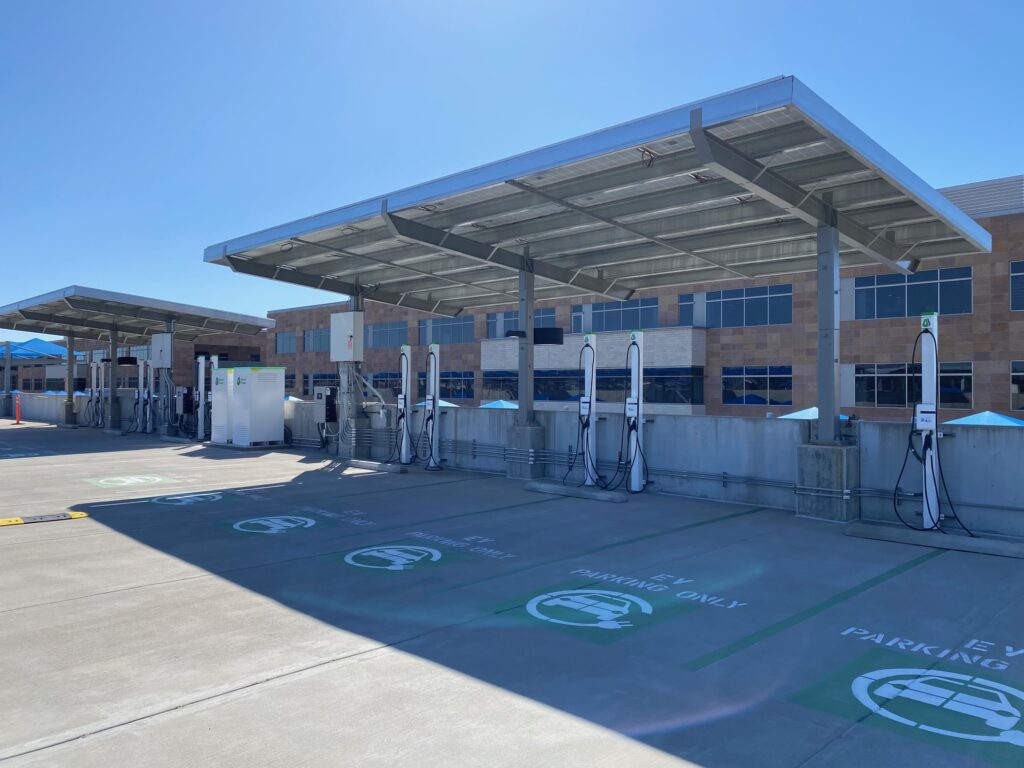
A solar carport puts solar panels above parking spaces, providing shade while generating electricity for EV charging.
At Paired Power, we combine solar with battery storage and software that manages how power reaches your vehicles. The battery stores energy for when it’s needed. The software balances charging with available solar, stored energy, and grid power to help keep electricity costs under control.
That matters when everyone plugs in at the same time. Instead of allowing all the chargers to pull maximum power from the grid, the system manages charging across the time vehicles are parked.
For employees spending the day at work or fleet vehicles parked between shifts, that flexibility can make a substantial difference in how much charging your site can support.
What Affects Solar Carport EV Charging Cost
There isn’t one standard price for a commercial solar carport charging system. A workplace adding a few chargers has different needs from a fleet yard charging dozens of vehicles every night.
To compare your options, look at the full installed cost of each approach.
Chargers and Electrical Work
The chargers are only part of the budget. Trenching, conduit, electrical panels, installation, and permitting can all affect the final cost. Where you place the chargers and how far they are from available power also matter.
Utility Upgrades
If your existing electrical service cannot support the charging you need, a conventional installation may require a utility upgrade. Get both a cost estimate and an expected completion date before building your plan around it.
Solar Panels and Battery Storage
A solar carport system includes the canopy, solar panels, battery storage, supporting electrical equipment, and energy management software. Its size depends on how much energy your vehicles need, when they need it, and how much grid power is available.
Parking layout, foundation requirements, and construction conditions also affect the price.
A solar carport may cost more upfront than installing chargers at a site with plenty of available power. When the alternative requires a major utility upgrade, the comparison can look very different. Solar also generates electricity that can reduce charging costs after installation.
Where the Savings and Payback Come From
Solar carport EV charging payback depends on the costs the system helps you avoid and the savings it delivers over time.
Avoiding a Utility Upgrade
If solar, batteries, and managed charging allow you to use your existing electrical service, you may be able to avoid some or all of an expensive upgrade.
That reduces the upfront cost compared with the upgrade option. It can also help you move ahead sooner, especially if fleet vehicles are already on order.
Reducing Demand Charges
Many commercial electric bills include demand charges. These charges are based on how much power your site draws at once during the utility’s billing intervals, rather than simply how much electricity you use over the month.
Several EVs charging together can create a costly new peak. Battery storage and energy management help limit that peak by supplying stored energy and spreading charging over the available hours.
Check your bill for a line labeled “demand” or “kW.” If those charges are significant, managing charging demand should be part of your project planning.
Buying Less Electricity From the Grid
Solar panels generate electricity where your vehicles park. Using that energy for charging reduces the amount you need to purchase from the utility.
Battery storage adds flexibility by saving solar energy for later use. The value depends on your electricity rates, local solar production, and charging schedule.
To estimate payback, compare the complete project cost with expected annual savings, including operating and maintenance expenses. Keep avoided construction costs separate from ongoing bill savings so you can see what drives the result.
A Workplace Charging Example From Intuit
At Intuit’s San Diego campus, available grid capacity was limiting the company’s plans for employee EV charging.
Paired Power’s PairFleet system combined solar canopies, battery storage, and intelligent energy management to support 24 EV charging positions using about 20 kW of available grid capacity.
According to our published Intuit case study, the project reduced energy and demand costs by approximately 80%, with a reported payback period of less than five years. Read the Intuit case study.
Those results reflect Intuit’s site and operating conditions. They show what is possible when the system is designed around actual charging needs and electricity costs.
When a Solar Carport Makes Sense
Solar carport EV charging is worth evaluating if:
- Your utility has quoted a costly upgrade or a long wait for additional power.
- Your organization pays for employee or fleet charging and wants to lower that expense.
- Vehicles stay parked long enough to manage charging around their schedules.
- Your electric bill includes substantial demand charges.
- You have suitable space for solar and expect to use the site for years.
Sites with ample grid capacity and low electricity costs may have less financial reason to add solar and storage. Energy management alone may be a useful first step.
The right design depends on how much energy your vehicles need and how long they stay parked. Those details help determine the mix of solar, battery storage, and available grid power.
How Workplace and Fleet Charging Differ
At a workplace, employees often park for much of the day. That gives the system time to charge vehicles while solar panels are producing electricity.
Fleet charging starts with the operating schedule. How far do vehicles travel? When do they return? When does each one need to leave again?
A fleet charging overnight may use battery storage to save daytime solar energy for evening use. A fleet parked during the day may be able to use more solar energy directly. Charging requirements vary by vehicle and route, so the design needs to reflect how your fleet actually works.
Find Out What Works for Your Site
Before investing in EV charging infrastructure, it helps to know how each option would perform at your location.
Paired Power uses Pairiscope, our EV charging and microgrid design software, to evaluate charging needs alongside solar production, battery storage, available grid capacity, and utility costs. Explore Pairiscope.
We can help you compare approaches and understand whether a solar carport, energy management, or a combination makes sense for your workplace or fleet.
Contact Paired Power with your site address, a recent electric bill, and a brief description of your charging needs. We’ll help you evaluate your options and plan your next step. Contact our team.